
Demilec Attic Air Sealing: The San Jose Owner’s Guide
If you have a Demilec spray foam attic and air sealing that’s failing or underperforming, we stock and install the matching products to bring it back to spec, typically between $1,400 and $3,200 for a full attic air sealing package in San Jose depending on square footage and how much existing foam needs to be removed first. We run trucks across San Jose daily, so most Demilec air sealing callbacks can be scheduled same-week, often within 48 hours. Most San Jose homeowners discover the problem the hard way: a bedroom that won’t hold temperature, a musty smell near the attic hatch, or an energy bill that climbs a little higher every summer month while the AC runs nonstop through Willow Glen and Almaden Valley heat waves.
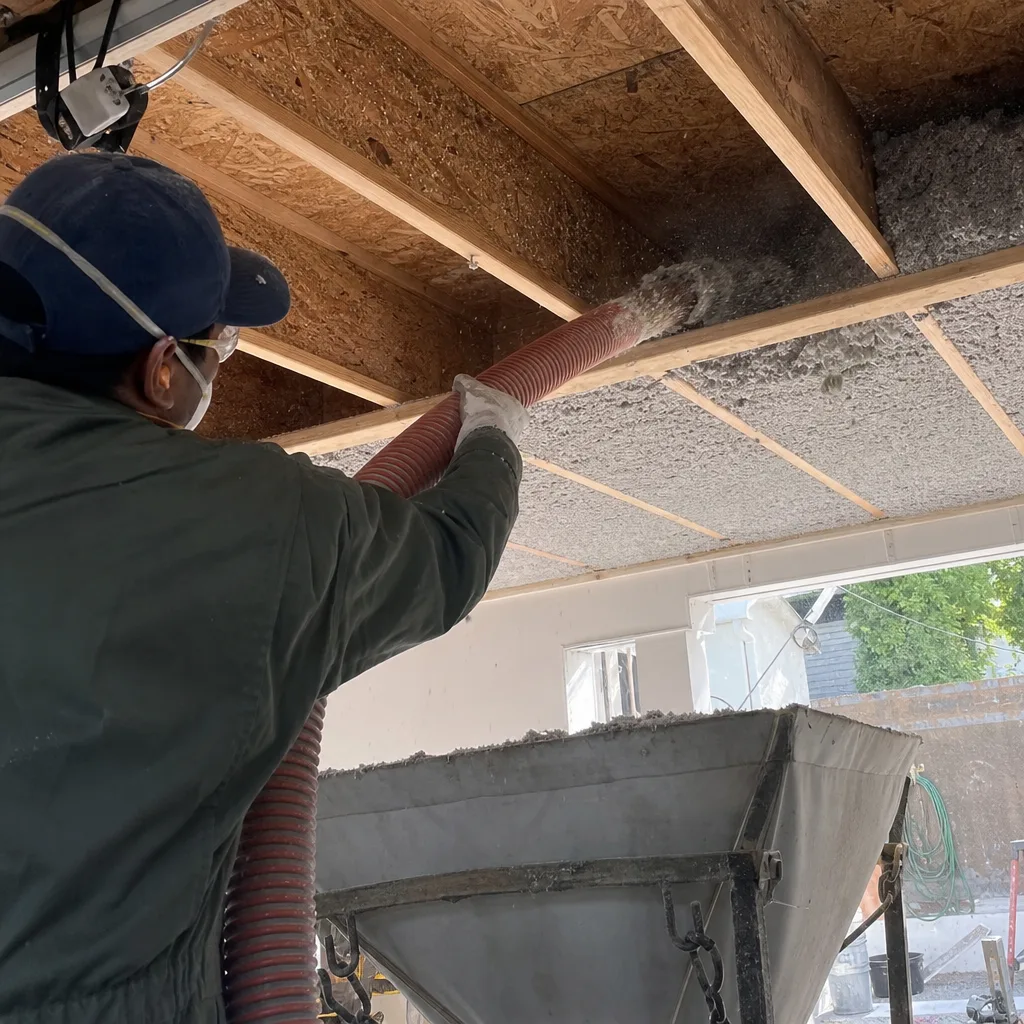
You don’t need a new roof or a bigger HVAC unit. You need the air barrier fixed, and if your home was sealed with Demilec products originally, patching it correctly matters more than most contractors admit.
Which Demilec Models This Applies To
The Demilec line used in residential attics across San Jose falls into two families: open-cell Sealection 500 and closed-cell Heatlok HFO. Sealection 500 is the half-pound open-cell foam most older San Jose homes received, typically applied 5 to 7 inches at the attic floor or roofline. Heatlok HFO is the newer closed-cell product, usually 1 to 2 inches, that doubles as an air barrier and vapor barrier in one pass.
The compatibility gotcha most people miss: these two products do not bond to each other cleanly. If your attic has Sealection 500 and someone patches it with closed-cell Heatlok, the foam can delaminate at the seam within a season or two, especially with San Jose’s temperature swings between hot summer days and cool coastal nights. We match the patch product to what’s already in your attic.
You can identify what you have with a quick visual: open-cell Sealection 500 is soft and sponge-like, with a matte finish you can press a thumb into. Heatlok HFO is rigid, denser, and has a slight sheen. If you can’t tell or the label is buried under insulation, call us and we’ll identify it during the estimate.
OEM vs. Aftermarket for Demilec
For Demilec air sealing specifically, we don’t use aftermarket equivalents on the foam product itself. The chemical compatibility between open-cell and closed-cell foam is too specific to gamble on. What does have aftermarket flexibility is the supporting hardware: attic hatch gasketing, can light covers, and the aluminum tape used at foam terminations. We stock those in galvanized and foil-backed versions that perform equally well or better than the original, but the foam itself is always matched to the Demilec product already in the home.
Walt’s Insulation is an independent service provider, not affiliated with Demilec or its distributors.
Signs Your Demilec Attic Air Sealing Is Failing
- Rooms directly under the attic won’t hold temperature. This is the classic Sealection 500 shrinkage signal. Over 10 to 15 years, open-cell foam can pull back from framing members a quarter inch or more, opening continuous air channels you can’t see from the hatch. We find this constantly in San Jose homes built during the 2005 to 2012 building boom, when spray foam installs were everywhere and quality control was uneven.
- An unexplained uptick in the energy bill, summer after summer. Air leaks get worse gradually, not overnight. If your PG&E bill creeps up 8 to 12 percent a year with no change in household habits, the air barrier is the first place to look.
- Dust or insulation fibers collecting around ceiling light fixtures. Air moving through the building envelope carries dust with it. When can light housings or ceiling penetrations were never properly sealed, you’ll see graying around the trim rings. That’s attic air being pulled into your living space, and whatever’s up there comes with it.
- A musty smell near the attic access or upstairs hallway after rain. Failed air sealing lets humid outdoor air into the attic, where it condenses on the underside of the roof deck. San Jose’s winter rain season makes this one show up reliably every year between November and March.
- Visible gaps between the foam and the framing. If you can see daylight or a crack where foam meets a rafter or top plate, the seal is gone at that point. Where there’s one gap, there are usually twenty more you can’t see without pulling back insulation.
Replacement Cost & What’s Included
For San Jose homes, a Demilec attic air sealing remediation runs between $1,400 and $3,200 installed. The range comes down to three things: how many square feet of sealing surface the attic has, how much failing foam needs to be cut out and removed first, and whether the problem is isolated to a few penetrations or spans the whole attic boundary.
Here’s what we include on every Demilec air sealing job:
- Full attic inspection with a written map of every penetration, gap, and seam that’s leaking.
- Removal of failed foam where it’s shrunk, cracked, or separated from framing.
- Matching Demilec-compatible foam application to restore the air barrier, not just cover it.
- Can light covers and hatch gasketing where ceiling penetrations are the source of the leak.
- Before-and-after photos so you can see exactly what we fixed.
Every job is covered by the Done Right Promise, which is lifetime workmanship coverage, not a two-year warranty that expires when the phone stops ringing. If it’s not done right, we make it right. That’s the whole deal.
Call (408) 837-7384 for a written estimate. Estimates are free, and if you have a quote from another San Jose contractor already, bring it in and we’ll give you a second opinion on it at no charge.
DIY or Call Us?
You can safely do the inspection part yourself: look for gaps between foam and framing, check the attic hatch for a worn gasket, and note any rooms that run hot or cold. That’s useful information and it helps you understand what we’re quoting.
The application side is a different story. Spray foam in an attic is not a caulk gun job. If you’re dealing with open-cell Sealection 500 shrinkage or closed-cell Heatlok separation, a blind patch with a hardware store foam can actually make things worse by trapping moisture against the framing, and in San Jose’s wet winters that’s a rot invitation. There’s also the heat factor: attic temperatures in a San Jose summer afternoon run 120 to 140 degrees, and foam chemistry reacts differently in that heat than it does at room temperature. That’s why we bring gear rated for the environment and why a rattle can from the home center won’t hold up.
If you want to try the small stuff like hatch weatherstripping, go for it. If the foam itself is the problem, call (408) 837-7384 and talk to someone who does this every week. Do it right or do it twice, and we’d rather not see you twice.
FAQs
Properly installed Demilec foam air sealing can last 20 to 30 years, but San Jose’s climate, with its wide temperature swings and seasonal moisture, realistically puts most failing installs from the 2005 to 2012 era at the 10 to 15 year mark before shrinkage or separation shows up. Call (408) 837-7384 and we’ll tell you honestly whether yours is at the end of its useful life or has years left.
Most failures can be repaired without removing all the existing foam. We cut out the shrunk or separated sections, address the air leakage points, and reapply matched Demilec-compatible product to those areas. Full removal is only necessary when the original install was done poorly across large sections, which we see most often in track homes built fast between 2005 and 2010. Call (408) 837-7384 and we’ll tell you which situation you’re in before anyone picks up a tool.
A typical San Jose Demilec air sealing remediation takes one full day for most homes under 2,500 square feet. Larger attics or jobs requiring significant foam removal can run two days. We show up in uniform, background-checked crews, and you’ll know the schedule before we start.
Yes. Our San Jose service trucks carry both Sealection 500 open-cell and Heatlok HFO closed-cell product, plus the related sealing hardware including hatch gaskets, can light covers, and foil tape. We also keep Reflectix products on hand for radiant barrier applications where they’re part of the air sealing scope. If your attic needs a patch, we can usually handle it the same visit.
Talk to a Real Person About Your Attic
If your Demilec attic air sealing isn’t doing its job, you don’t need a lecture about energy efficiency. You need someone to climb up there, find the leak, and fix it so it stays fixed. Walt’s Insulation has been doing exactly that for San Jose homeowners since 2000, with a real address, a real license number, and a lifetime Done Right Promise behind every job. Walt Brenner still answers the phone himself, and if he’s mid-ladder, someone else on the team picks up. You’ll never wait for a call center.
Call (408) 837-7384 for a free estimate, and remember: seniors and veterans always get 10 percent off, and we never charge a trip fee anywhere in Santa Clara County.
Written by Walt Brenner, Owner, Walt’s Insulation at Walt’s Insulation, serving San Jose and nearby areas.