
CertainTeed Radiant Barrier Installation: The San Jose Owner’s Guide
We stock and install CertainTeed-compatible radiant barrier in San Jose every week, with most single-family attic jobs running between $1,800 and $3,400 installed, depending on square footage and access. We’re usually on-site within 48 hours, and same-day or next-day installs are common when we’re already working in your neighborhood. Most San Jose homeowners call us after discovering their old radiant barrier has delaminated from the roof decking, or after a summer where the upstairs bedrooms stayed 10 degrees hotter than the thermostat said they should.
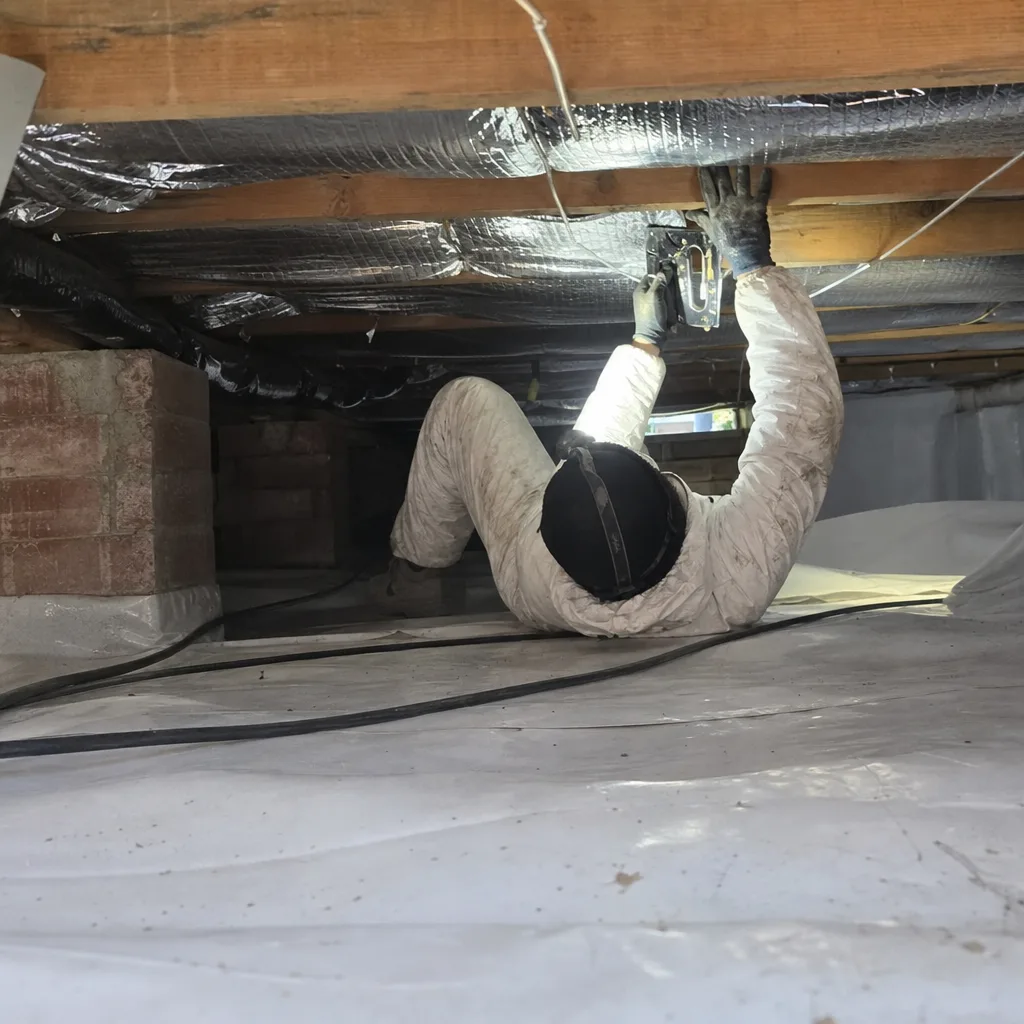
Radiant barrier failures are rarely dramatic. You won’t hear a bang or see smoke. What you’ll notice is the air conditioner running longer, a July electric bill that climbs year over year, and an attic that feels like a sauna when you open the hatch. That’s the part failing quietly, and by the time you feel it inside the house, it’s been underperforming for a season or two.
Which CertainTeed Models This Applies To
CertainTeed makes two radiant barrier product lines we regularly install and replace: CertainTeed EZ Frame, a perforated foil-faced sheathing-style barrier designed for new construction and full re-roofs, and CertainTeed Reflex, a heavier single-foil product used in retrofit applications when the roof deck isn’t coming off. If you’re not sure which one is in your attic, look for the printed CertainTeed label on the foil facing near the ridge line, or check the perforation pattern: EZ Frame has visible micro-perforations across the entire sheet, while Reflex is a solid, smooth foil with no holes.
Here’s the compatibility gotcha that catches people in San Jose: EZ Frame is installed over the roof sheathing, under the shingles. If your home was built between roughly 2010 and 2019 in a San Jose development tract, there’s a good chance certain EZ Frame panels are already up there, and what you’re actually replacing is a failed section, not a standalone attic retrofit. Reflex, on the other hand, staples to the underside of the rafters inside the attic. Mixing the two on one roof voids the thermal-performance assumptions. We match whatever is already installed, and if you’re unsure, we’ll confirm it during the free estimate visit. Walt’s Insulation is an independent installer, not a CertainTeed dealer or affiliate, so our recommendation is based on what performs in San Jose’s climate, not what one manufacturer wants us to push.
Signs Your CertainTeed Radiant Barrier Installation Is Failing
- Upstairs rooms run 8 to 12 degrees warmer than downstairs in summer. Radiant barrier reflects heat before it becomes attic air temperature. Once it delaminates or the foil oxidizes, that heat loads directly into your ceiling insulation, and the upstairs is the first place you feel it.
- Visible sagging, tears, or foil peeling away from the substrate in the attic. This is the most common failure mode we see in San Jose. The adhesive bond between the foil and the backing breaks down after years of thermal cycling, especially in attics that hit 140°F in August. Walk up with a flashlight and look for foil hanging like loose wallpaper.
- Dust coating the foil’s shiny surface. Radiant barrier only works when the reflective surface is clean and facing an air gap. A layer of dust cuts its reflectivity dramatically. In older San Jose homes near Almaden Expressway or along the 87 corridor, attic dust accumulates faster than people expect.
- Your AC runs constantly from 2pm to 8pm on hot days, even when the thermostat holds. That’s the sign the radiant barrier isn’t reducing the heat load on the attic insulation below it. Your HVAC isn’t the problem; the thermal envelope is.
- Energy bills creep up each summer compared to previous years, with no change in household habits. A degrading radiant barrier doesn’t fail all at once. It loses efficiency gradually, and your PG&E bill is the most honest diagnostic tool you own.
Replacement Cost & What’s Included
For San Jose attics, here’s what we quote, installed:
- Small attic (up to 800 sq ft): $1,800 to $2,300
- Medium attic (800 to 1,400 sq ft): $2,300 to $2,900
- Large attic (1,400 to 2,000+ sq ft): $2,900 to $3,400+
These numbers include removal and haul-off of the old failed material, the CertainTeed-compatible replacement product, all staples and fasteners, labor, and a full attic inspection while we’re up there. What pushes a job toward the high end: low-pitch roofs with tight access, attics where the old barrier was glued rather than stapled, and homes with extensive ductwork or electrical we have to work around. Every quote is upfront, line-itemed, and locked before we start. There’s no trip charge anywhere in Santa Clara County, and if you have a written estimate from another company, we’ll give you a free second opinion on it. Our work is covered by the Done Right Promise for life: if the installation isn’t done right, we make it right, no runaround.
DIY or Call Us?
Radiant barrier installation involves working in a confined, extremely hot attic space, often standing on joists with a pneumatic stapler overhead. It’s not high-voltage dangerous like an electrical panel, but it is hot, dusty, and awkward work, and a misstep through a drywall ceiling is a $600 mistake before you’ve even gotten the product hung. What you can safely check yourself: whether the existing foil is sagging or torn, whether the shiny side is dusty, and whether there’s any visible label identifying the CertainTeed product line. What we don’t recommend doing yourself is removing failed barrier that’s stapled over fiberglass batts, cutting and fitting sheets around truss bracing and can lights, or working on a steep-pitch roof. If you’ve found failed radiant barrier and want it handled correctly the first time, call Walt’s Insulation at (408) 837-7384. Do it right or do it twice, and we’d rather not see you twice.
FAQs
In San Jose’s climate, a properly installed CertainTeed radiant barrier typically lasts 15 to 20 years before its reflectivity degrades enough to matter. Attics here see extreme temperature swings, and that thermal cycling is what eventually breaks down the foil-to-substrate bond. If your barrier is 15+ years old and you’re noticing sagging, it’s time. Call (408) 837-7384 for a free attic assessment and we’ll tell you honestly whether it’s still doing its job.
It depends on the failure mode. Small tears in a few sheets can often be patched with a compatible foil product, and we’ll do that when it makes sense. But when the adhesive bond has failed across most of the attic, or the foil is heavily oxidized and dusty, patching is throwing good money after bad. We’ll give you a straight answer after seeing it in person, not over the phone. Estimates are free, and a repair over $200 qualifies for $40 off.
Most San Jose attic radiant barrier installations are completed in one day, typically 4 to 8 hours depending on attic size and access conditions. Larger homes with complex truss layouts can take two days. We protect your floors and furniture paths, clean up fully, and haul away all old material the same day. Call (408) 837-7384 and we’ll give you a schedule that fits yours.
We keep CertainTeed-compatible Reflex and EZ Frame products on hand and stocked on our trucks for immediate installation. We also carry Reflectix for crawl space and small-project applications when that’s the better fit. If we tell you we can install it this week, the material is already in our warehouse in San Jose, not on backorder.
Written by Walt Brenner, Owner, Walt’s Insulation at Walt’s Insulation, serving San Jose and nearby areas.