
GreenFiber Attic Insulation: The San Jose Owner’s Guide
GreenFiber attic insulation in San Jose homes typically costs $1,800 to $4,200 installed, depending on attic square footage and the R-value you’re targeting. We stock GreenFiber cellulose and SANCTUARY blow-in products on our trucks, and in most San Jose neighborhoods we can have a crew out same-day or next-day. The call usually starts the same way: a homeowner noticed their energy bill creeping up, or they went into the attic for the first time in years and saw the insulation has settled into sad, compacted drifts that don’t come close to covering the joists anymore.
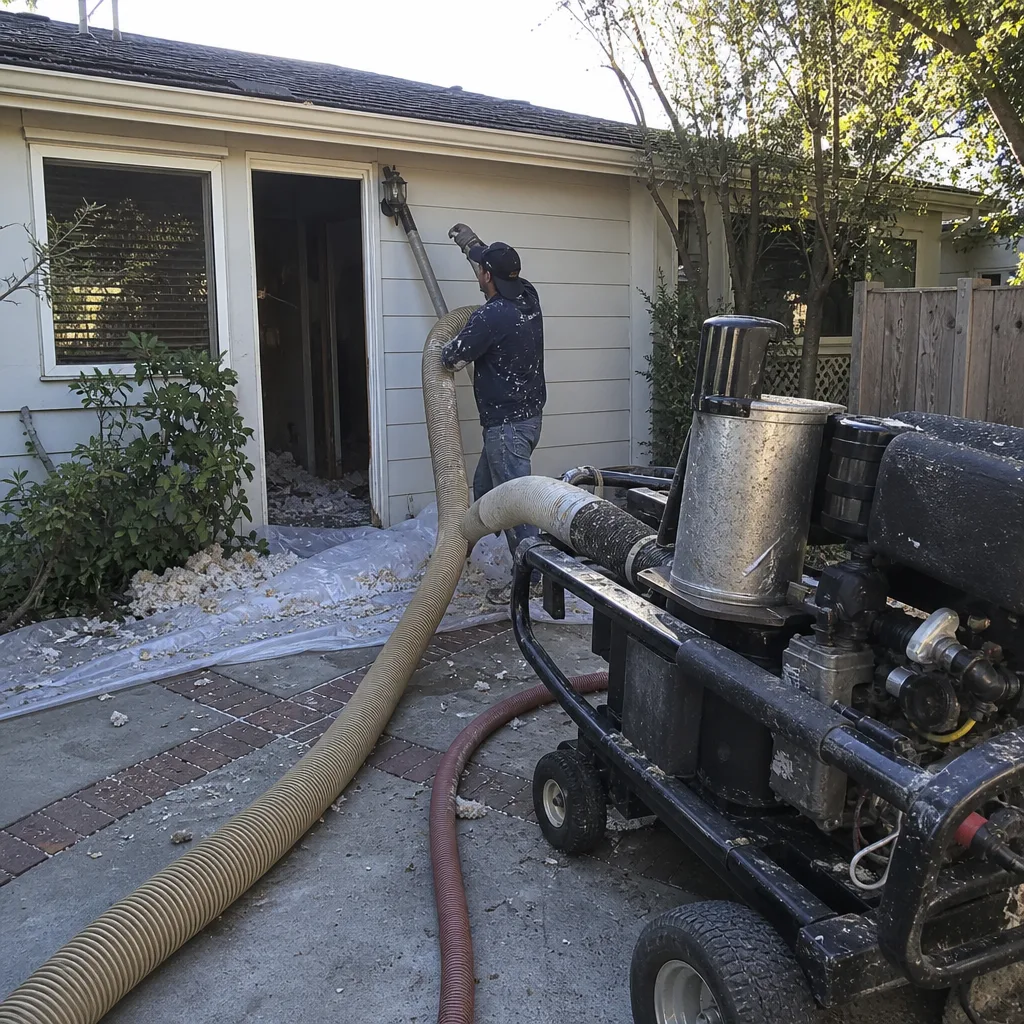
That’s the thing about blown-in cellulose that nobody tells you when it goes in the first time. It compresses. GreenFiber’s own specs assume a certain installed density, and a lot of the attics we see in Willow Glen, Almaden Valley, and Berryessa were blown in two or three decades ago at rates that left them light on day one. Add a few San Jose summers where the attic hits 130 degrees, a couple of rainy winters that let moisture sneak past a failed bath fan vent, and you’ve got insulation that’s lost a solid third of its effective R-value. You can’t un-settle it. You replace it or you top it off.
Which GreenFiber Models This Applies To
GreenFiber makes two product lines we work with regularly: their standard INS550LD cellulose insulation and the SANCTUARY by GreenFiber line, which is treated with borates for added fire resistance and pest deterrence. Both are loose-fill blow-in products, and both install with the same equipment. The difference matters if you’re topping off an existing attic: SANCTUARY goes in at a slightly different density than the standard line, and mixing the two without accounting for the coverage chart can leave you under-insulated in spots.
Here’s the compatibility gotcha most San Jose homeowners don’t know: if your attic was insulated in the 1990s or early 2000s, there’s a good chance it’s an older GreenFiber formulation that settled more aggressively than current products. You can add today’s GreenFiber product right on top of old GreenFiber without removing it, as long as the old material is dry and doesn’t have rodent activity. If it’s damp or packed with droppings, topping it off just buries the problem. We’ll tell you straight which way your attic needs to go, because Walt Brenner has been in enough San Jose attics to know what a lost cause looks like from the ladder.
We’re an independent insulation contractor, not a GreenFiber dealer or affiliate. That means when we recommend GreenFiber, it’s because it’s the right product for your house, not because we’re pushed to move a particular brand’s inventory.
Signs Your GreenFiber Attic Insulation Is Failing
- Your summer cooling bill keeps climbing while your AC runs constantly. San Jose’s summer heat loads are brutal, and settled cellulose loses its loft and its trapped-air pockets. Less trapped air means the attic heat conducts straight down into your living space. We’ve measured attics in Evergreen where the effective R-value was barely half what the original install was supposed to deliver.
- Rooms on the second floor are consistently 8-12 degrees warmer than downstairs. Heat rises, and under-insulated attics punish upstairs rooms first. If you’d believe the thermostat setting but not the actual temperature in your bedrooms, the attic insulation is the first place to look.
- You can see the tops of your ceiling joists poking through the insulation. This is the easiest one to check. In a properly insulated San Jose attic, you shouldn’t see joists at all for an R-38 install. If they’re visible, you’re under-insulated, period. The joists become thermal bridges that channel heat straight into the ceiling drywall.
- The insulation looks flat or crusty in places. GreenFiber cellulose shouldn’t crust over. If it has, moisture got in at some point. That could be a roof leak, a disconnected bath fan vent pumping humid air into the attic, or simply years of coastal-adjacent San Jose humidity taking a toll. Crusty or matted insulation isn’t doing much insulating.
- You keep finding cellulose dust around recessed light fixtures or attic hatches. A little dust is normal. A constant fine sift of cellulose particles drifting down through fixtures means the material is breaking down or has been disturbed, often by rodents. That’s when a top-off becomes a removal-and-replace job, and yes, we do that too.
Replacement Cost & What’s Included
For a typical 1,200 to 1,800 square foot San Jose attic, a full GreenFiber blow-in to R-38 runs between $1,800 and $3,200. If you’re topping off existing insulation to bring it back up to spec, you’re looking at $900 to $1,500. Smaller attics or spot-fix jobs can come in under that. Larger homes, or attics that need old insulation removed first, push toward $4,200 and occasionally beyond.
| Job Scope | Typical San Jose Range | What Changes the Price |
|---|---|---|
| Top-off existing insulation to R-38 | $900 - $1,500 | Attic access ease, existing material condition |
| Full blow-in, 1,200-1,800 sq ft attic | $1,800 - $3,200 | Attic size, final R-value, prep work needed |
| Removal of old/damaged insulation + new GreenFiber | $2,800 - $4,200+ | Removal volume, rodent contamination, air sealing added |
Every quote includes the insulation material, equipment, labor, and cleanup. We don’t add a line item for hauling off old material mid-job, and we don’t quote one number then show up and “discover” problems that double the price. If we see a vent that needs moving or a hatch that needs weatherstripping while we’re up there, we’ll tell you what it costs before we touch it. All of it is covered by the Done Right Promise: lifetime workmanship. If it’s not done right, we make it right. No fine print, no runaround. And we’re the one down the road, with a published address and a real license number, not an 800 number that hands you off to a call center.
DIY or Call Us?
The parts of this you can safely check on your own: peek into the attic from the hatch and see whether joists are visible, check for crusted or matted areas, and look for any signs of water staining on the underside of the roof deck. That’s a five-minute inspection that tells you most of what you need to know.
What we don’t recommend doing yourself is the actual install. Blowing GreenFiber cellulose properly requires a commercial blower machine, the right density settings for the product, and someone who knows how to work around recessed can lights, soffit vents, and wiring without creating a fire hazard or blocking airflow. Do it wrong and you get an attic that looks full but performs like it’s half empty. We’ve seen weekend warrior installs in Cambrian and Blossom Valley that needed to be pulled out and redone because the coverage was so uneven. The equipment rental, the learning curve, the sawdust-and-cellulose mess: it’s one of those jobs where paying someone is actually the cheaper route. Call us at (408) 837-7384 and we’ll give you a straight number.
FAQs
GreenFiber cellulose has a manufacturer-stated lifespan of 20 to 30 years under normal conditions, but in San Jose’s hot attic environment, real-world effective performance often drops off after 12 to 15 years due to settling and moisture intrusion. The insulation doesn’t stop insulating entirely, but it loses R-value as it compresses. If your attic was blown in during the early 2000s, it’s worth having it checked now.
In most cases you can top off settled cellulose with more GreenFiber rather than removing everything, which saves a lot of money. The exceptions are when the old material is wet, moldy, or full of rodent droppings. In those cases, removal and replacement is the only real fix. We’ll tell you which camp you’re in after one look at the attic.
A standard top-off for a San Jose home takes 2 to 3 hours from setup to cleanup. A full removal and replacement usually runs half a day to a full day depending on attic size and what we find up there. We bring the equipment, the material, and the manpower to get it done in one visit.
We stock GreenFiber cellulose and SANCTUARY blown-in insulation in our shop, and our trucks carry it to jobs all over Santa Clara County. We also work with Owens Corning, Johns Manville, Knauf, Rockwool, CertainTeed, and Reflectix when a home calls for something different. For most San Jose attics, GreenFiber is on the truck and ready to go the day you call.
If your attic insulation has settled, soaked, or simply never been right, call us at (408) 837-7384. You’ll talk to a live person, not a phone tree. We’ll give you an honest assessment, a free estimate, and if you’ve got a written quote from someone else, we’ll give you a free second opinion on it. Seniors and veterans always get 10% off, no hoops. And if you book a repair over $200, mention this page and we’ll knock $40 off. Do it right or do it twice, and we’d rather not see you twice.
Written by Walt Brenner, Owner, Walt’s Insulation at Walt’s Insulation, serving San Jose and nearby areas.